One carousel workflow. Built for daily operation.
Carousel Factory is built to write the post, design the slides, and publish to LinkedIn, Facebook and Instagram on a cloud schedule. Public activation is paused while reporting accuracy, independent alerts, platform coverage, and onboarding are corrected.
These three slides were actually published.
Not mockups. Slides 1, 3 and 6 of a real six-slide carousel that went out to all three platforms on 7 August 2026, rendered by the engine with no human touching the design.
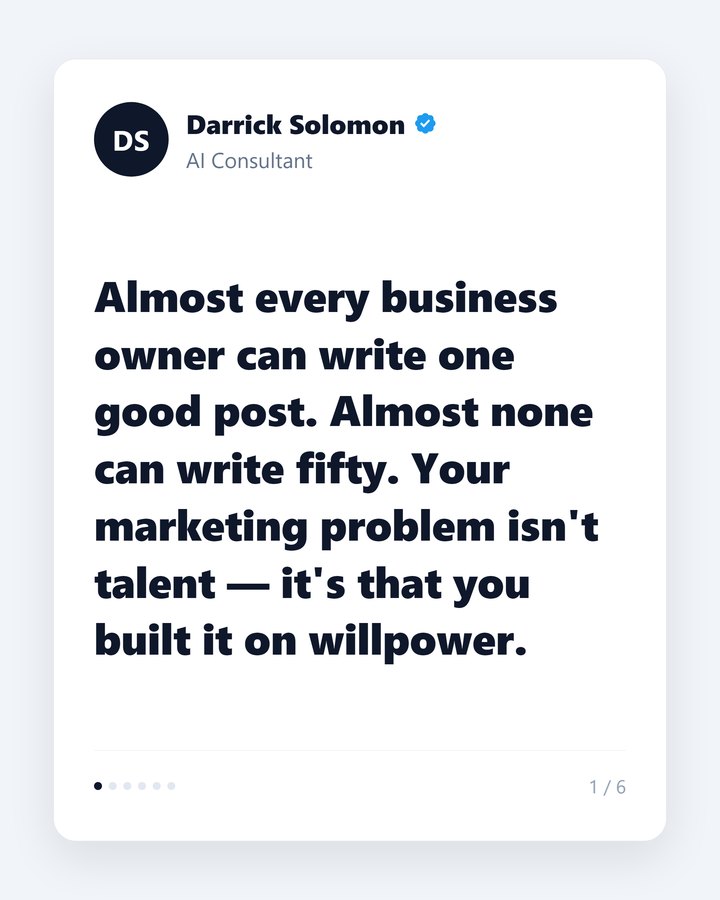
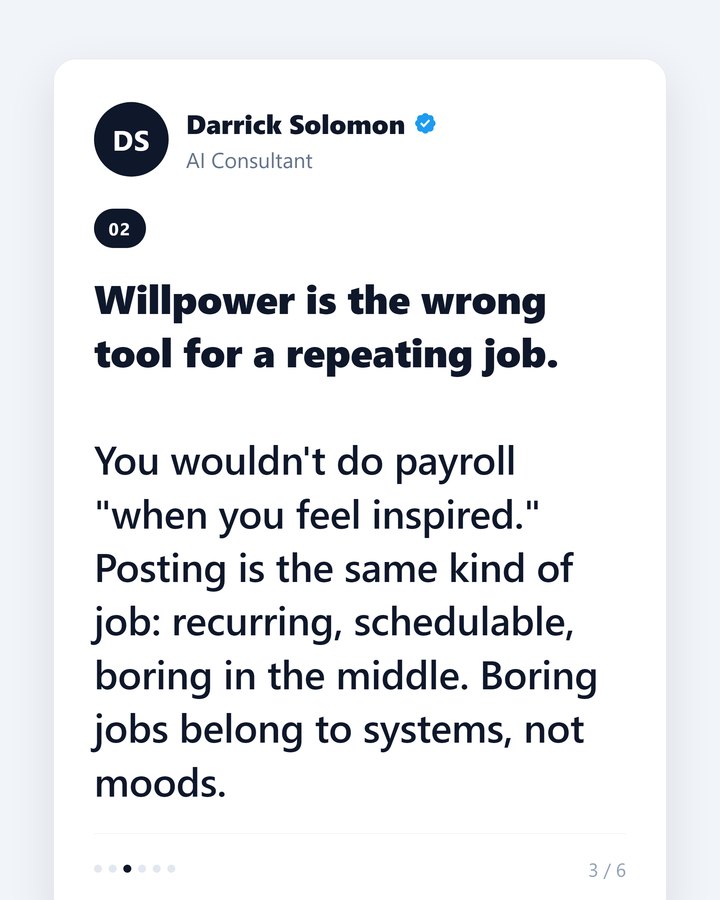
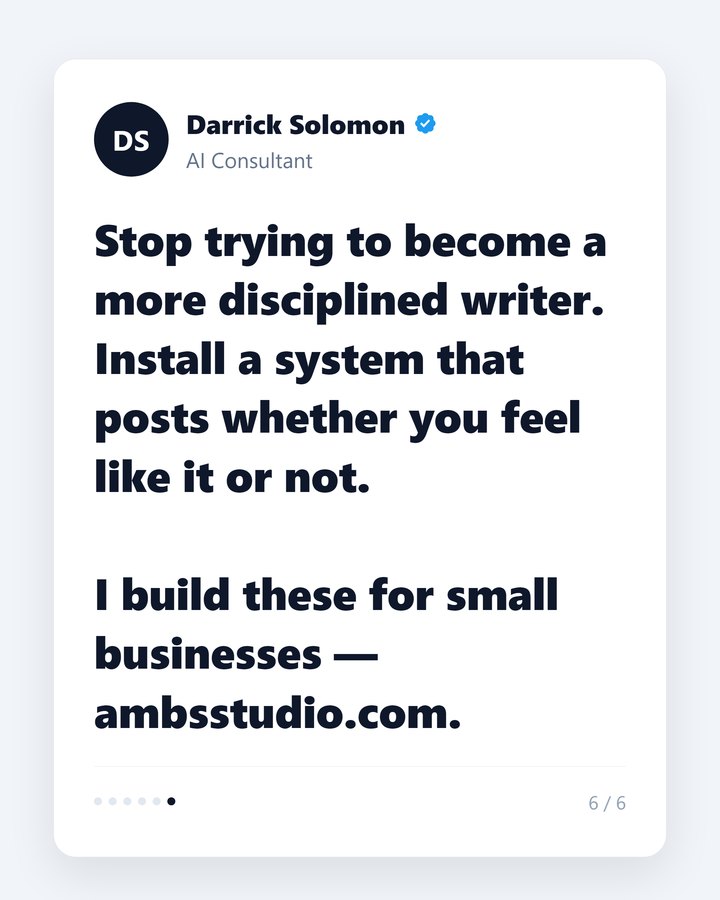
You can go and look at it. The Instagram copy of this carousel is public at instagram.com/p/DbvdY2AII4Y. The first fully autonomous post went to LinkedIn on 4 August 2026; the 7 August test published successfully to all three platforms.
Four things happen while you are doing something else.
A topic comes off the queue
You approve topics in batches. The engine takes the next one on its scheduled date — a calendar event is the go-order.
The words get written
A strong model writes the hook and the body. This is the only step that costs anything, and it is deliberately not run on a cheap model — the hook is the product.
The slides get drawn
Rendering is plain code — HTML to PNG, same input, same pixels. No model is involved, so every slide after the copy costs nothing.
Publish, then report
The intended flow publishes to the connected platforms, then produces a scorecard. Current run freshness and failure reporting remain part of the hold review.
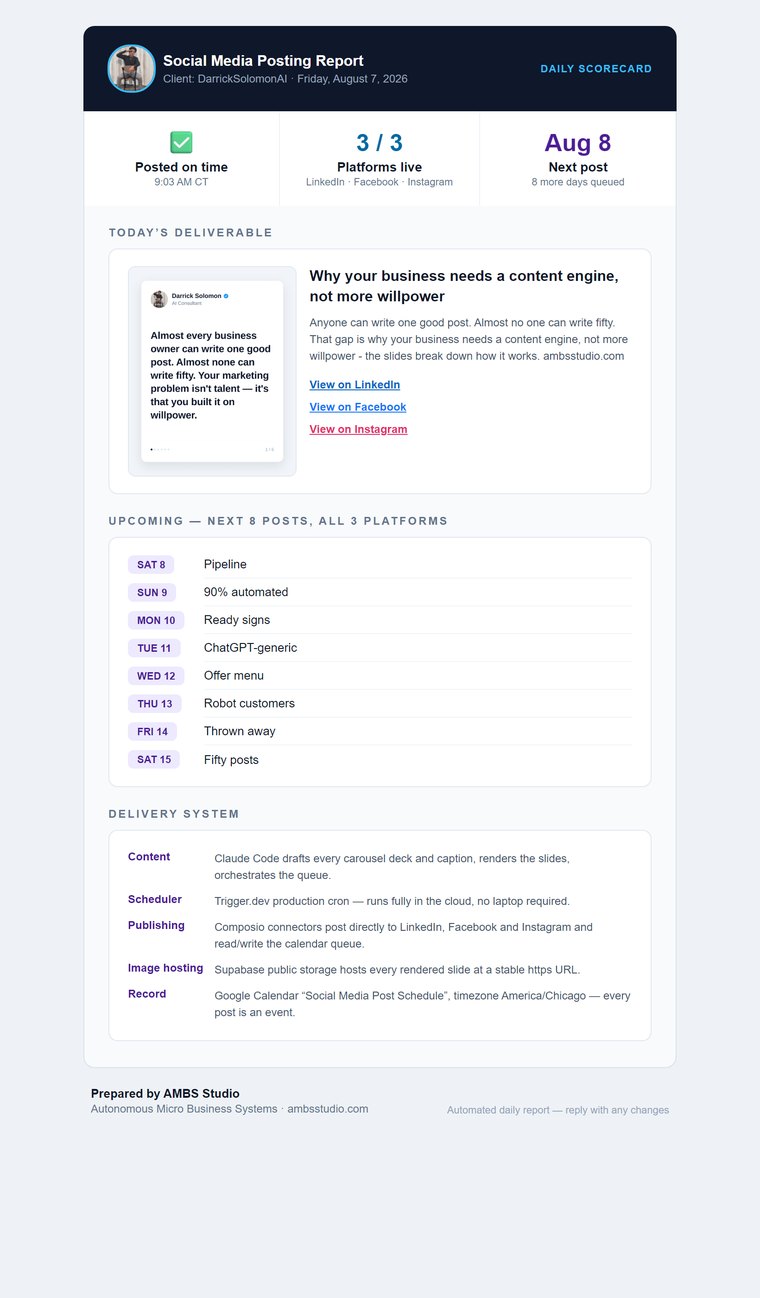
The report is designed to show what happened.
The example below is historical proof from 7 August. The audit found that partial platform failures were not always counted correctly, so public release remains on hold.
-
01Did it run?
Three tiles across the top answer the only question that matters before coffee: posted on time and at what minute, how many platforms went live out of how many were meant to, and when the next post lands with how many days are still queued behind it.
-
02Today's deliverable
The actual first slide as a picture, the headline, the caption exactly as it was published, and a separate live link for each platform —
View on LinkedIn,View on Facebook,View on Instagram. You click through and see the real post. -
03What's coming
The next fortnight of posts, dated, so nothing is a surprise and you can veto a topic days before it goes out rather than after.
-
04The numbers, in four windows
Engagements, likes, comments, replies you answered, shares, link clicks, reach and follower count — each shown for the last post, 30 days, 6 months and the year, so one loud day never reads as a trend. Where a platform does not expose a number, the cell says so instead of inventing one.
-
05What to do about it
A short recommendations block: the area, what to change, why, and the specific next action. When the audience is too small for the numbers to mean anything, it says that — rather than dressing up noise as insight.
-
06When something breaks
The corrected report must name every failed platform in red as NOT posted and an independent heartbeat must alert on silence before this product is released.
About the picture: that is the genuine 7 August edition, reporting the same carousel whose slides are above. The four-window analytics table and the recommendations block were added to the report later that week, so they sit below the schedule in the current version and are not visible in this capture.
The rest of what it does.
Your calendar is the approval
Every scheduled post is an event on a Google Calendar you can see. Moving it moves the post; deleting it cancels the post. Creating one is the go-order — nothing publishes that you did not put on the calendar.
Two designed slide styles
A clean editorial thread look and a bolder graphic one, with layout variety chosen from the content itself — quotes, big numbers, split cards — so six slides never look like the same slide six times.
Same input, same pixels
Rendering is deterministic. Re-run a post a month later and you get byte-identical slides, which is why a design change can be reviewed before it ships instead of being discovered in the feed.
Slides get a permanent home
Every rendered slide is stored at a stable public URL, so the images in your report and in your posts keep working long after the run that made them.
Written by the good model
Research runs on a cheap model; the hook and body do not. That split is deliberate — the first line is the product, and it is the one place the cost is worth paying.
Up to twelve slides
Six by default because that is what performs, but a longer argument can run to twelve — the cap every platform enforces anyway.
What is true today — and what is not.
AMBS Studio publishes the gap between the marketing and the product. Here is this one's.
True right now
- ✓It was proven on a real account beginning 4 August 2026; current run freshness is part of the hold review.
- ✓The runtime is cloud-side when its scheduler and account connections are healthy.
- ✓Slide rendering is deterministic and free — no model call, no per-image cost.
- ✓The report format exists, but its success counts and independent delivery monitoring are under correction.
Not true yet
- ✗Public activation is on hold. Customer onboarding, platform connection, and topic setup are not ready for general release.
- ✗It has run on one account so far. You would be the first outside its owner.
- ✗LinkedIn posting is personal profile only. Company pages need a permission we do not currently hold.
- ✗Engagement numbers are near zero — the accounts are days old. The engine works; the audience does not exist yet.
The boring details, stated plainly.
| Platforms | LinkedIn (personal profile), Facebook Page, Instagram Business |
|---|---|
| Cadence | 1 carousel per day, 9:00 AM Central |
| Slides per post | 6 by default, up to 12 |
| Daily report | 10:15 AM Central, by email |
| Runs on | Cloud scheduler — no computer of yours stays awake |
| Cost to render a slide | $0.00 — it is code, not a model |
| Instagram limit | 1 post per day during account warm-up |
| Status | Public release on hold pending operational remediation |
What people ask before public release.
Straight answers, no sales copy. If yours isn't here, email us — see below.
How fast can I actually get started?
General activation is paused. The next release gate is a verified onboarding and monitoring path that does not depend on a manual workaround.
What do you need from me to set it up?
Access to the three accounts you want it posting to (LinkedIn personal profile, a Facebook Page, an Instagram Business account), and a first batch of topics or talking points to seed the queue. We handle the connection and configuration.
What does it cost?
No price is being offered while the product is on hold. Pricing will be published only after the operational and customer-delivery gates pass.
Can it post to a LinkedIn company page instead of my personal profile?
Historical tests used a LinkedIn personal profile, Facebook Page, and Instagram Business account. Current platform coverage and permissions are being reverified; LinkedIn company pages need a permission we do not hold.
Do I have to approve every post before it goes out?
Your Google Calendar is the approval. Every scheduled post is an event you can see — move it and the post moves, delete it and the post is cancelled. Nothing publishes that wasn't put on the calendar in the first place.
Is the content generic, or does it sound like my business?
You approve topics in batches, and the hook and body are written by a strong model, not a cheap one, because the first line is what makes someone stop scrolling. It's built from the topics and angle you give it, not a generic template.
What happens if a post fails to go out?
The audit found that partial platform failures could be reported as full success. Public release remains on hold until the report names every failed platform correctly and an independent alert catches silence.
Follow the remediation.
The engine is not accepting general activations. The catalog will keep the listing on hold until reporting, monitoring, platform coverage, and onboarding are proven.